The Gap between Local Academic Research and HR Practice in Saudi Arabia
If you ask an HR consultant providing advisory services to a Saudi company about local academic references they use in their work, the answer is very likely to be NONE. While a good number of academic research related to HR is published every year in Saudi universities or by Saudi scholars (a requirement for academic advancement), there is no evidence that such research is utilized in practice.
Typically, HR academic research finds its way to practice either by (a) direct relationship between universities and companies, or more commonly through (b) consulting firms by reviewing the research, summarizing it in practical language, and using it in their consulting models. As of the direct relationship, this is rare in the Saudi context, as most such relationships are in technical and scientific fields.
For consulting firms (mostly International for larger companies), they usually use academic knowledge produced elsewhere to formulate their models and solutions to Saudi clients. While such knowledge is generally applicable to the local environment amid increasingly globalized practices, much of the particularities of the local culture is lost. For example, while Saudi culture is typically classified as group-oriented rather than individual-oriented (as for example in the work of Hofstede), most of the proposed HR solutions are geared towards the individual. In most Saudi companies performance management ends with individual employee appraisal that is ranked along a certain distribution and calibrated accordingly. While the general cultural sentiment values the group, excessive focus on individual performance leads to competition among employees for the higher ratings, rather than collaboration to support group performance.
It is disheartening to see the efforts of many researchers end up in library shelves with no practical utilization. I think there is a need to bridge the knowledge production gap between academic research and practice. And consultants are best positioned to be the “knowledge brokers”.
Interesting case study on how to engage employees for great results
The case study in the below link shows how asking employees for ideas to make small reductions to customer wait time led to great results. Innovation is not limited to big ideas, but also to accumulated small ideas!

Employee Engagement in Saudi Arabia: Need for More Studies
Over the last few years, I have been searching for publicly published studies on the level of employee engagement in Saudi companies. Unfortunately, I found only one study by Gallup conducted in 2019 and then 2022. The Gallup study was based on phone interviews by 1,000 people working in Saudi companies, both nationals and residents (please find link below). I was happy to see that the levels of employee satisfaction and engagement have increased between 2019 and 2022.
However, the scope, sample and methodology of this study is very limited. There is a need for larger samples across geographical regions and economic sectors, as well as wider coverage of employee perceptions. For example, the study can include (1) perceptions on the effectiveness of key HR programs, such as performance management, learning and development and rewards, (2) consistency of announced corporate values with actual practice, such as innovation and teamwork, (3) relationship with managers, colleagues and subordinates, and (4) wellness.
I hope that one of the Saudi universities or research institutes takes the initiative to introduce such a study on periodical basis. It will be of great value for corporate leaders, researchers, and management consultants, as well as for the relevant governmental agencies.
Link to the Gallup study: https://www.gallup.com/workplace/403382/saudi-arabia-workplace-trends-report.aspx
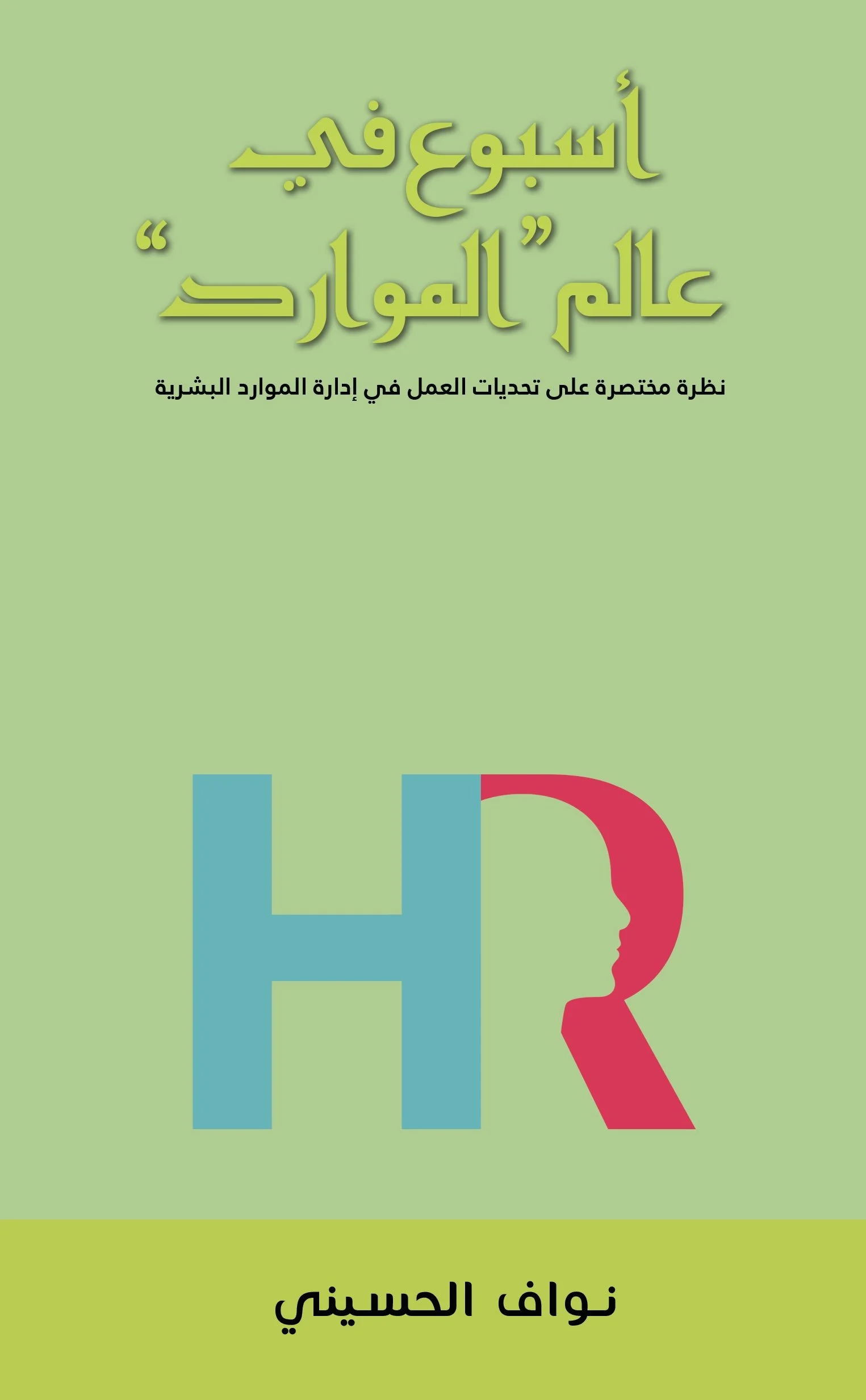
Book: A Week in the World of HR
I wrote this book (in Arabic) to provide an easy-read of HR challenges for HR students and young HR professionals to help them further understand the expectations and context of the HR function. I hope it delivers the intended value.
I wrote this book (in Arabic) to provide an easy-read of HR challenges for HR students and young HR professionals to help them further understand the expectations and context of the HR function. I hope it delivers the intended value.

A Touch of Green
Towards Green HR Policies in Saudi Companies
Towards Green HR Policies in Saudi Companies
In different capacities, Saudi companies have embraced green initiatives to support environmental protection. Examples abound of manufacturing companies using emission control technologies, banks providing favorable terms for green loans, and businesses using energy more efficiently, reducing printed material, and managing waste more effectively. And there is a surge in sustainability reporting among the larger companies in response to the Capital Market Authority 2021 guidelines to promote ESG reporting (Environmental, Social and Governance), and ESG committees are being formed. With all such efforts it can be said that the Saudi corporate landscape has responded well to Vision 2030’s call for going green.
Acknowledging these developments, one may ask if more can be done. Perhaps yes, by engaging the corporate workforce more broadly, and reflecting the green momentum in HR policies. There is no evidence that Saudi companies have updated their HR policies to reflect their green drive and ESG programs, and as such they may be losing more opportunities to advance the green agenda.
Are all employees aware of how they can contribute to environmental protection through their jobs? And once aware do they have incentives to do so? Obviously, there is a segment of employees who are directly involved in environment-related objectives, such as industrial engineers, as well as those involved in ESG initiatives. But those comprise a small segment of the workforce.
By updating HR policies with the green drive, more engagement of the workforce can be attained, and small ideas here and there may grow larger and spread from one company to another. Updating HR policies is more significant than introducing stand-alone programs, as they signal to managers and employees that the green drive is formally institutionalized. In other words, policy update will ensure sustainability of the green drive.
But what does updating HR policies with the green drive mean exactly. Here are a few examples, noting that documentation of such update requires only adding a few statements to existing policy, and does not need a whole rewriting of the HR policy document:
· Training policy: Add environmental awareness to annual training plans. Some companies are already offering this training, but it is not clear if this is a matter of HR policy or a stand-alone, one-off ESG program. Such training should include dialogues and workshops on how employees can contribute through their jobs, and more generally as members of the organizational community.
· Performance management policy: Add green objectives for each employee. This can be mandatory or optional, depending on the job, but in all cases, it should be counted in the performance reviews and ratings. For example, if green objectives are optional for certain jobs, individual green achievements can be counted as an extra effort that can contribute to the overall performance rating.
· Recognition program policy: Include green achievements, both at the individual and team levels. A policy update will ensure that future recognition programs are inclusive of green achievements.
· Job description policy: Add “green mindset” as part of the requirements for all jobs. This is important as the job description is the basis of most HR programs.
· Recruitment policy: Include environmental protection in the new hires orientation programs. This should signal to the employee early on that a green mindset will be beneficial to their career within the company.
· Employee engagement survey policy: Add questions on perceptions of the green drive and obstacles faced. This would allow tracking progress over time.
· Volunteering policy: Include participation in state-sponsored and other national and local green initiatives.
The “greening” of HR policies will be more effective if it is done with a positive spirit, highlighting the benefits for the quality of life now and for future generations. The language used in the policy document and in communication matters, in my opinion. It is better to avoid positioning the green HR as a compliance requirement, with terms such as “mandatory” and “must” to be avoided. Viewed as another compliance requirement imposed from the top amid heavy workloads might lead to creative means to go around it, rather than advance it. The objective is not to have employees and managers aim towards minimum effort to check the box, but rather to have a great sense of purpose in embracing the green agenda.
Engaging the workforce more broadly in the green drive through HR policy updates will better institutionalize it in all facets of the organization. As of now, ESG seems to be an isolated mandate under the purview of the top managerial tier and applicable to only some segments of the business. Furthermore, ESG is not only about the environment, and corporate efforts may focus more on the “S” and “G” rather than on the “E”.
What would also help in this regard is research to assess the extent to which corporate-wide green programs are implemented and HR policies updated. There is limited academic research on green human resource management among Saudi companies, and none has addressed the impact on HR policies (for example, Nadia Abdulghaffar 2017, Mohammed Alharbi 2020, Sasha Faisal & Mohammad Naushad 2020, Nuha Alhashash 2022).